


- Nueva conexión a la red
- Modificar mi suministro
- Modificar el trazo de una línea actual
- Nueva conexión de generación
- Nueva conexión de autoconsumo
New network connection
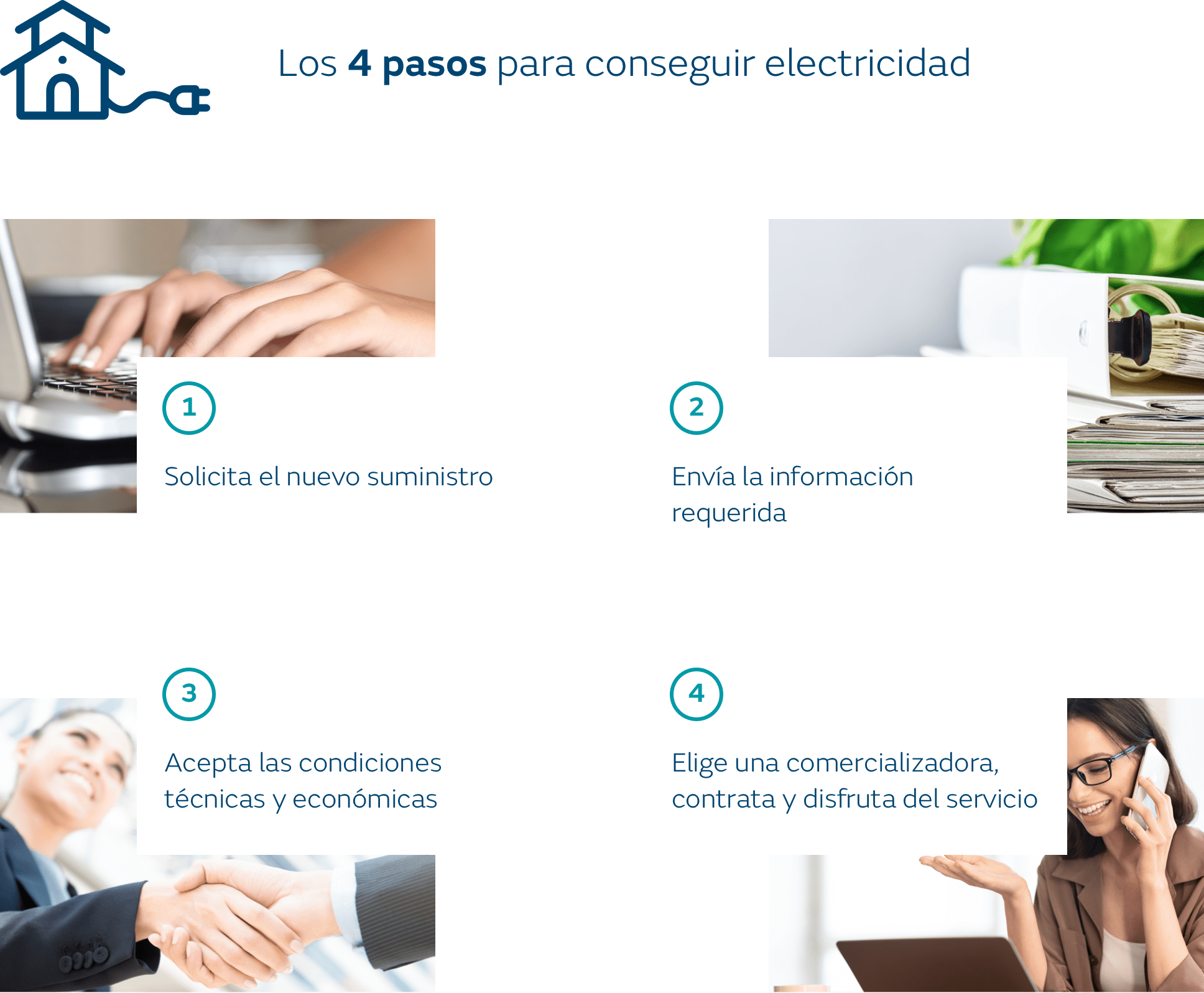
1

Request a new supply
You can request your new supply in the My network connections section of the Private Area. Private Area.
What information will we ask you for?
- Personal details: name, tax identification number (NIF/NIE), email address and telephone number.
- If you are a company: company name, tax identification number (NIF), email address and telephone number.
- Supply point details: voltage level, requested access capacity and identification of the installation location.
- Indication of the need for an extension quote.
Please remember that for the application process to be valid, it must comply with legal requirements at all times.
2

Send the required information
In order for the application to be accepted for processing, we will need additional information as required by regulation, so we will inform you of everything you need to send. If we find any errors in the documentation, you can correct them as provided for in the regulations.
You can send us the information through our digital services platform.
3

Accept the technical and financial conditions
Once we have reviewed your application, we will send you the technical and financial conditions for the work to be carried out in order to connect the supply, indicating the work that we will have to do and the work that you can have done by a specialist installer.
Once you have accepted the conditions and made the payment, we will get to work.
4

Choose a supplier, sign up and enjoy the service
When we have finished the work, we will notify you that your installation is ready and provide you with the CUPS (Universal Supply Point Code), which is essential for signing up for electricity supply.
Finally, choose a supplier (you can find them on the CNMC website), sign the contract and enjoy your electricity supply.
What types of supplies can you request?
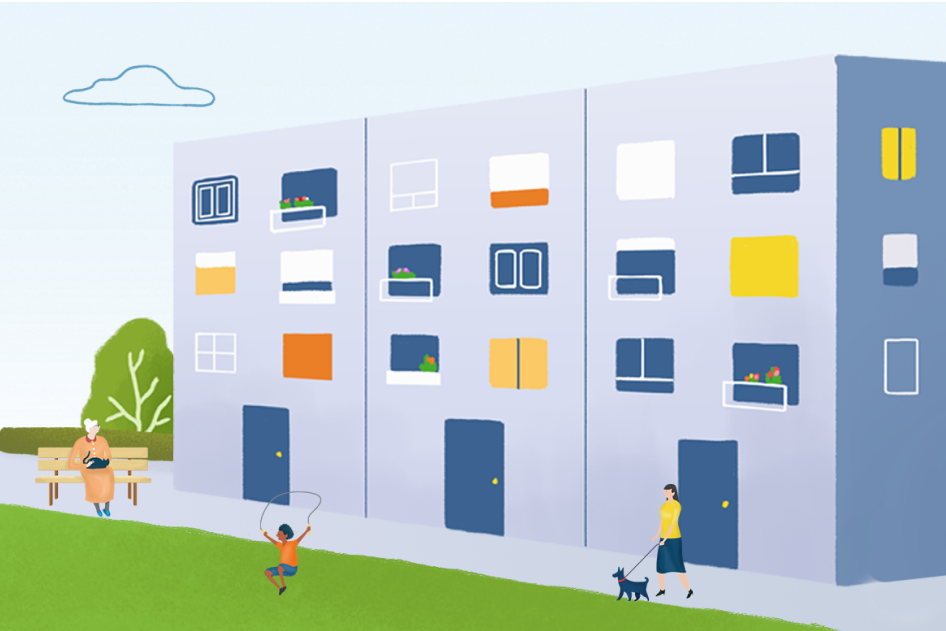
Residential use
- Single-family dwelling supply for a single dwelling, detached or within a locality.
- Block of flats: supply for buildings with several dwellings. A single file for the entire building. This type should not be used to request new supplies in existing buildings.
- Group of single-family dwellings: supply for several single-family dwellings. A single file for all the dwellings.
- Supplies in existing buildings: supply for a dwelling in a building where other supplies already exist.
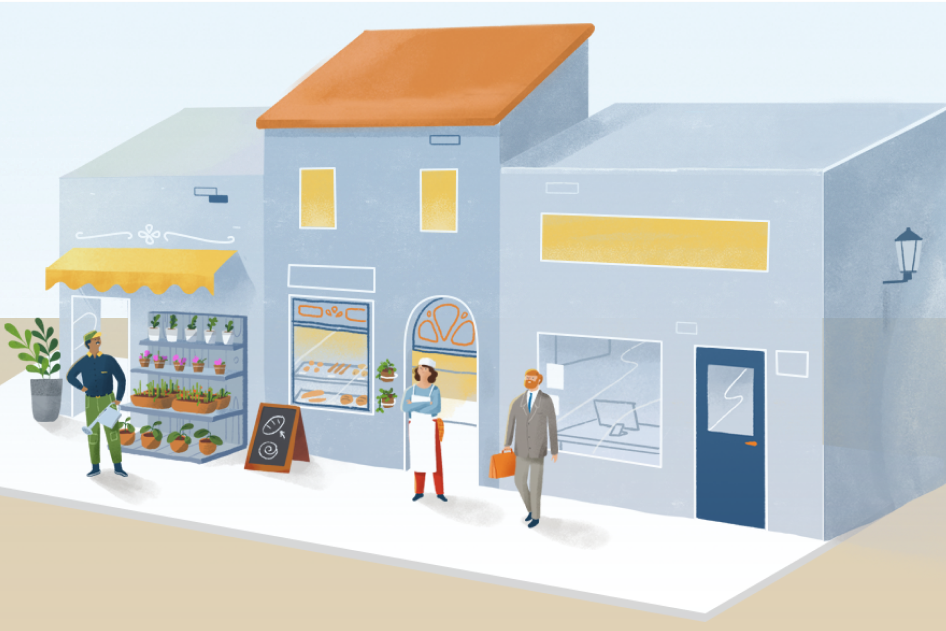
Non-residential use
- Office building: supply for buildings with several offices. A single file for the entire building. This type should not be used to request new supplies in existing buildings.
- Commercial use: any tertiary use supply (shops, hotels, etc.).
- Industrial supply (one supply): a single supply for an industrial warehouse.
- Industrial supply (multiple supplies): supply for multiple industrial warehouses. Make a single application for all warehouses.
- Agricultural use: supplies for irrigation, lighting, farm tool sheds on a non-residential and non-industrial property.

Special warranty
Supplementary supply associated with an existing main supply or generated at the same time on the same property as requested to ensure continuity or security of supply in order to have a second power source. Depending on the percentage of the contracted power of the main supply and the supplementary supply, it will be:
- emergency: if the power requested is between 15% and 24% of the power of the main supply.
- reserve: if the power required is equal to or greater than 25% and less than 50% of the power of the main supply.
- duplicate: f the power requested is equal to or greater than 50% of the power of the main supply.
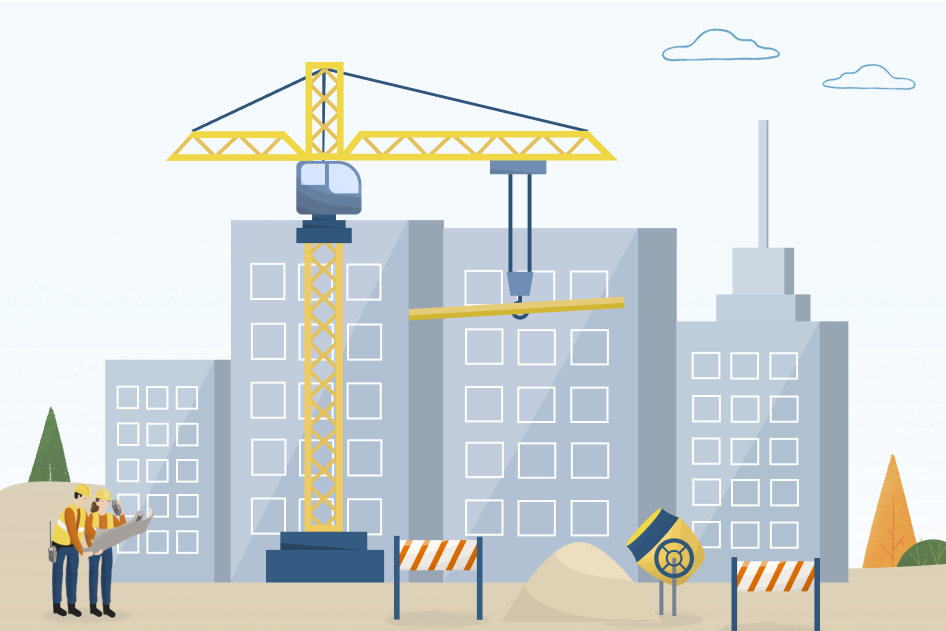
Construction supplies
Provisional and temporary supplies for construction works, for the execution of new buildings, repair, modification, extension or demolition of existing buildings, excavation works or similar works.
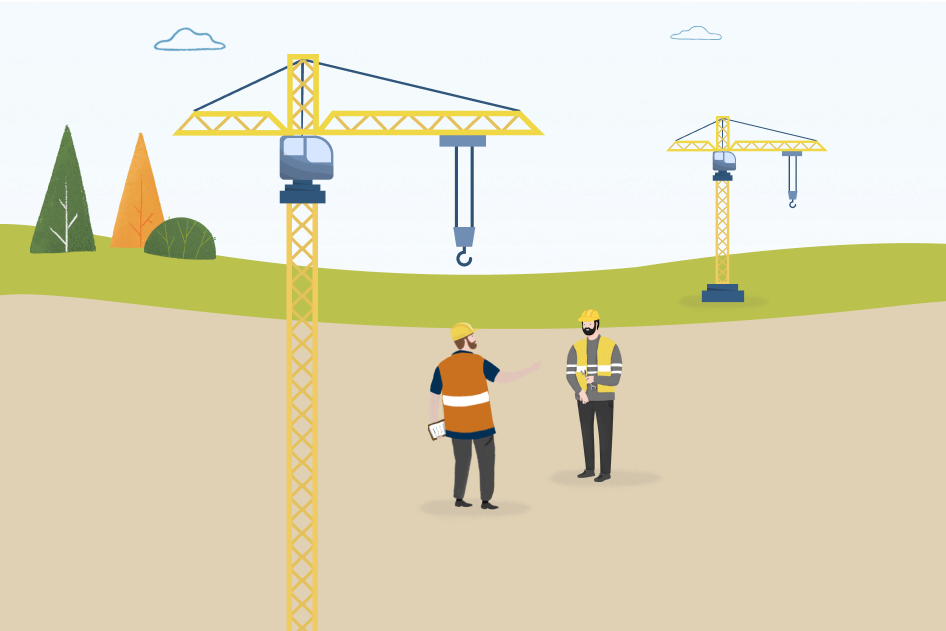
New urban development
Supply for an area to be developed, involving a change in cadastral use and provision of services in accordance with an urban development project.
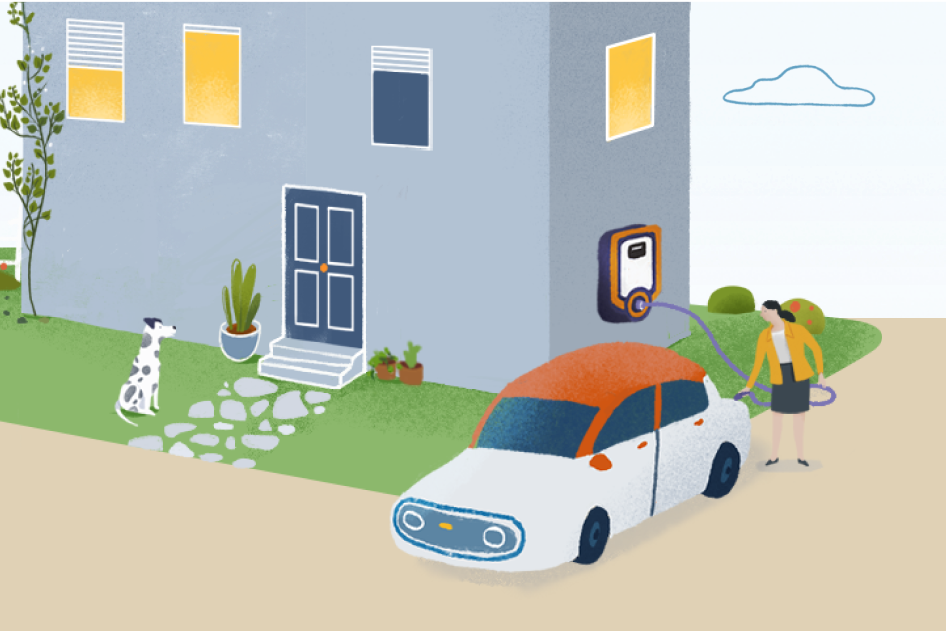
Electric vehicle charging
Supply intended for infrastructure for charging an electric vehicle.
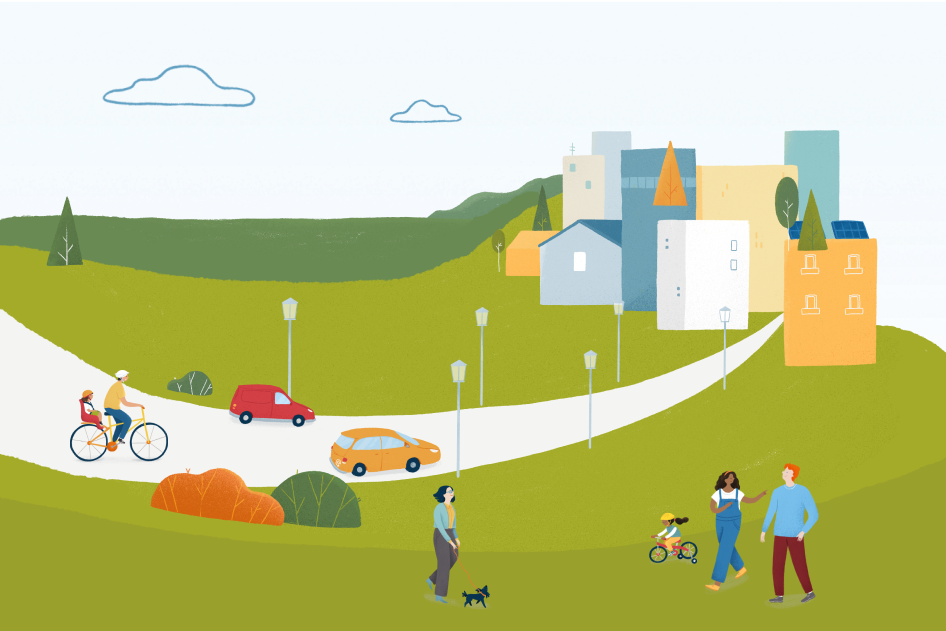
Supply on public roads
Permanent supply located directly on public roads to power any type of street furniture that requires connection to the electricity grid, such as street lighting, traffic lights, bus stop shelters, monuments, fountains, advertising hoardings, information panels, clocks or thermometers, public toilets, tourist information points, lottery or security booths, kiosks of any kind (newspapers, etc.), food stalls (ice cream, churros, etc.), communications nodes or equipment (fibre, cable TV, telephony, etc.), road or motorway gantries and, in general, any type of street furniture that requires connection to the electricity grid.

Temporary supplies
Temporary supplies for events such as fairs, festivals, orchestra stages, marquees, temporary markets (medieval, craft, etc.), festive street lighting and similar events.
Temporary supplies are available for up to two months and must be requested 40 days in advance.
To apply, please call our freephone number 900 111 999.
Find out the costs of connecting to the grid or increasing your power supply.
Whenever you request a new electricity supply, reactivate an existing one or increase your electrical power, you must pay the so-called connection fees, hook-up fees, installation verification fees and fees for work on metering and control equipment, which are regulated by Royal Decree 1048/2013 of 27 December (Articles 24, 25 and 29). Read more
Applicable legislation
Below you can find a list with part of the legislation that may be applied.
- Royal Decree 1955/2000, of 1 December, regulating the activities of transport, distribution, marketing, supply and authorisation procedures for electrical energy facilities.
- Royal Decree 1110/2007, of 24 August, approving the Unified Regulation on Measurement Points in the Electricity System.
- Royal Decree 1183/2020, of 29 December, on access to and connection to electricity transmission and distribution networks.
- Royal Decree 1048/2013>, of 27 December, establishing the methodology for calculating remuneration for electricity distribution activities.
- Royal Decree-law 23/2020, of 23 June, approving measures in the field of energy and other areas for economic recovery.
- Act 24/2013, of 26 December, of the Electricity Sector.
- CNMC Circular 1/2024, of 27 September, establishing the methodology and conditions for access and connection to the transmission and distribution networks of electricity demand facilities.
Applicable UFD regulations
Below you will find a list of some of the applicable regulations.
- IT.07971 Technical Requirements for Connection of High Voltage Installations of > 36kV.
- IT.07972 Technical Requirements for Connection of High Voltage Installations of ≤ 36kV.
- IT.07981 Technical Requirements for Energy Measurement in High Voltage Networks > 1kV in Electrical Substations.
- IT.07982 Technical Requirements for Energy Measurement in High Voltage Networks ≤ 36kV.
- IT.07978 Technical Requirements for Connecting Low-Voltage Electric Vehicle Charging Infrastructure.
- IT.07983 Technical Requirements for Energy Measurement in Low Voltage Networks..
- IT.07985 Types, measurement diagrams and connection diagrams for self-consumption in high voltage of ≤ 36kV.
- IT.07986 Types, measurement diagrams and connection diagrams for self-consumption in low voltage.
- IT.07988 Boxes and modular assemblies for low voltage connection installations.
- IT.07987 Boxes for high voltage measurement installations.
Modify my supply
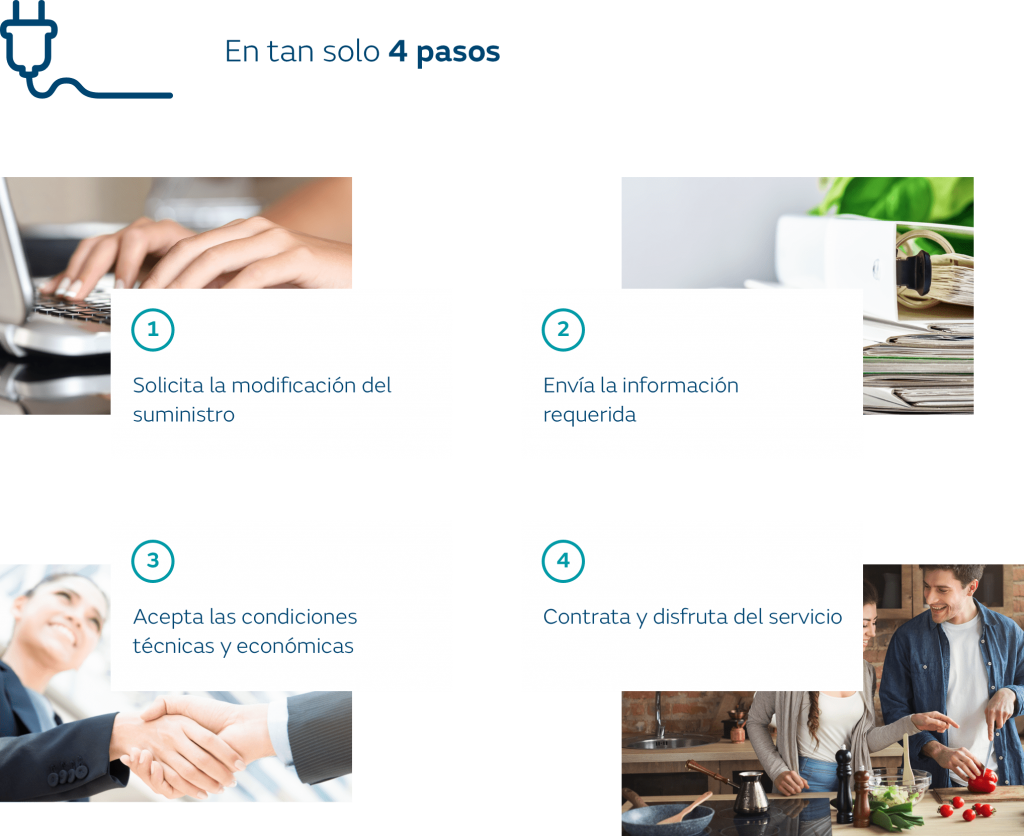
1
Request the modification
In the My network connections section of the Private area, you can modify the power of your supplies.
What information will we ask you for?
- Personal details: name, tax identification number (NIF/NIE), email address and telephone number.
- If you are a company: company name, tax identification number (NIF), email address and telephone number.
- Supply point details: CUPS code, requested access capacity and identification of the installation location.
- Indication of the need for an extension quote.
2
Send the required information
In order for the application to be accepted for processing, we will sometimes need aditional information as required by regulations, so we will inform you of everything you need to send. If we find any errors in the documentation, you can correct them as provided for in the regulations.
You can send us the information via the website.
3
Accept the technical and financial conditions
Once we have reviewed your application, we will send you the technical and financial terms and conditions.
Once we have reviewed your application, we will send you the technical and financial terms and conditions.
4
Sign up and enjoy the service
When we have completed the work, we will notify you so that you can enjoy your new power supply at your supply point.
Enjoy the service!
Applicable legislation
Below you will find a list of some of the applicable legislation.
- Royal Decree 1955/2000, of 1 December, regulating the activities of transport, distribution, marketing, supply and authorisation procedures for electrical energy facilities.
- Royal Decree 1110/2007, of 24 August, approving the Unified Regulation on Measurement Points in the Electricity System.
- Royal Decree 1183/2020, of 29 December, on access to and connection to electricity transmission and distribution networks
- Royal Decree 1048/2013>, of 27 December, establishing the methodology for calculating remuneration for electricity distribution activities.
- Royal Decree-ley 23/2020, of 23 June, approving measures in the field of energy and other areas for economic recovery.
- Ley 24/2013,of 26 December, of the Electricity Sector.
- Circular CNMC 1/2024, of 27 September, establishing the methodology and conditions for access and connection to the transmission and distribution networks of electricity demand facilities.
Modify the path of a current line
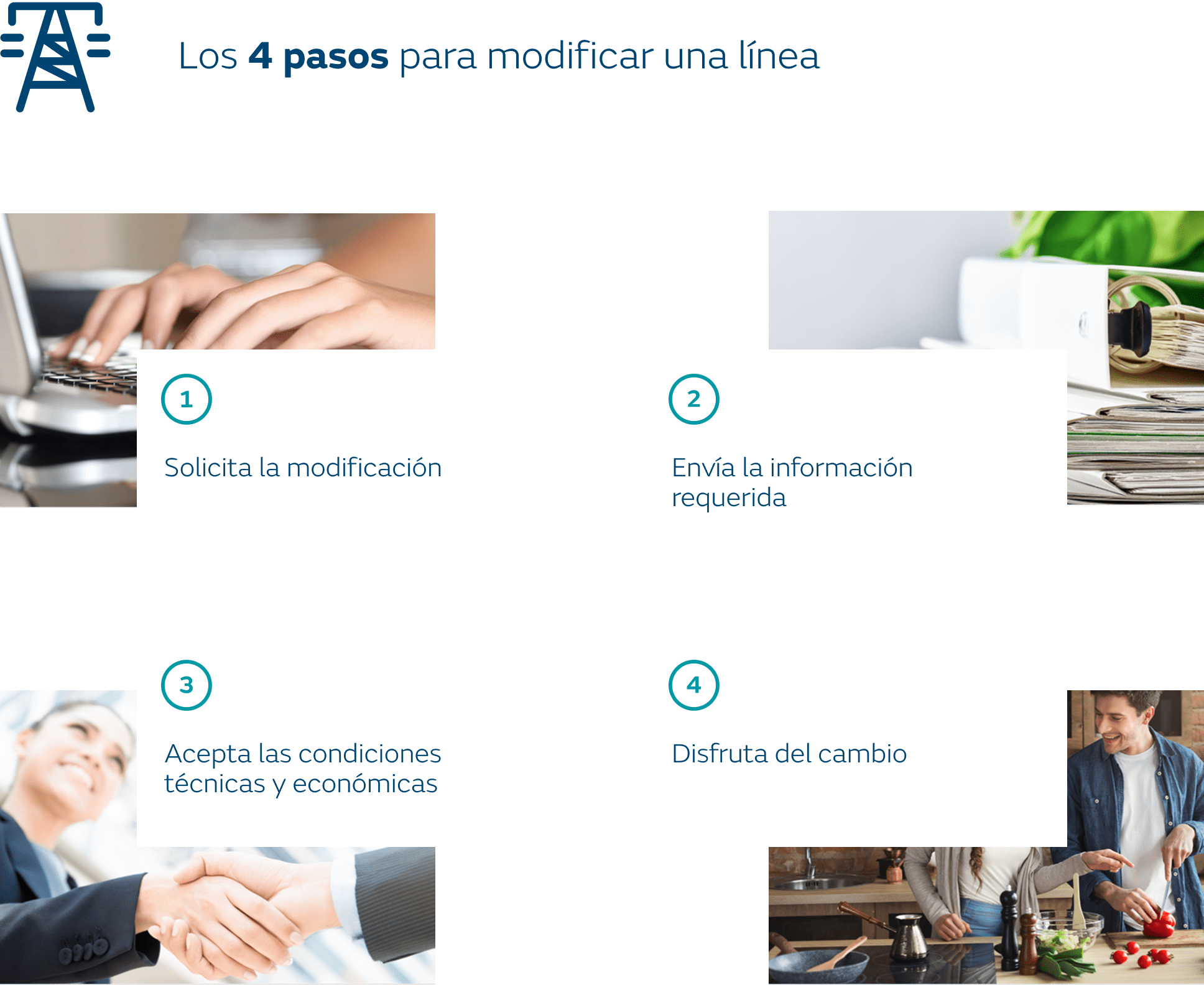
1
Request the modification
In the My network connections section of the Private Area, you can request a change to the layout of a line.
What information will we ask you for?
- Personal details: name, tax identification number (NIF/NIE), email address, telephone number.
- Details of the line to be modified.
- Permits from individuals, if applicable. See the permit templates.
2
Send the required information
In order to review your application, we may sometimes need additional information about the line, so we will let you know everything we need you to send us.
You can send us the information via the website.
3
Accept the technical and financial conditions
Once we have reviewed your application, we will send you the technical and financial conditions for the work to be carried out to divert the line.
The review will be subject to obtaining the relevant permits.
4
Disfruta del cambio
Cuando acabemos los trabajos, te avisaremos de que la modificación de la instalación está lista y te informaremos de ello.
¡Esperamos que disfrutes de la modificación de línea!
New generation connection


Submit your application
- Go to the My grid connections section of the Private area. ¡Register now!
- We will ask you for the following information:
- Personal details (name, tax identification number, email address, telephone number)
- Details of the type of installation
- Details of the power station (name, cadastral reference, power)
- Send us the documents we specify
- Remember that for the application process to be valid, the application must comply with legal requirements at all times.
- Do not forget to open your application at a point with sufficient access capacity for generation. Check the capacity here
We will send you the preliminary proposal and the financial conditions
- Once we have validated the documentation, we will study the application, taking into account the characteristics of your installation.
- Please note that your installation must comply with current legislation, regulations and technical documentation.
- We will send you the preliminary proposal.
- We will send you the financial terms and conditions.
- If we have requested it, you can now make the payment.
- In some cases, we may need to request the following documentation before reviewing your installation:
- The CIE
- The 59N report review (for medium voltage cases)
- The connection request
- Access and connection permits are granted once the technical conditions have been accepted.
We connect you
- Once we have reviewed it, you will be able to connect your installation.
- Don't forget that you will need to manage:
- the technical contract with UFD or your distributor.
- the access contract with your supplier.
Submit your request
- Go to the My grid connections section of the Private area. ¡Register!
- We will ask you for the following information:
- Personal details (name, tax identification number, email address, telephone number)
- Details of the type of installation
- Details of the power station (name, cadastral reference, power)
- Snd us the documents we specify
- If the installation requires it under current legislation, Red Eléctrica de España must confirm access to the transmission grid.
- Remember that for the application process to be valid, the application must comply with legal requirements at all times.
- Do not forget to open your application at a point that has sufficient access capacity for generation. Check the capacity here
We will send you the preliminary proposal and the financial conditions
- Once we have validated the documentation, we will study the application, taking into account the characteristics of your installation.
- We will send you the preliminary proposal.
- We will send you the financial terms and conditions.
- You can now make the payment.
- And we will get started on the work.
- Access and connection permits are granted once the technical conditions have been accepted.
We connect you
- Once the work is complete, we will check the meter installation, provide you with the CUPS code and authorise your connection.
- Now contact the supplier of your choice and sign the ancillary services contract. You can find a list of suppliers at www.cnmc.es

Applicable legislation
Below you can find a list with part of the legislation that may be applied.
- Códigos de red y Norma de Técnica de Supervisión de Generadores
- Royal Decree Ley 23/2020
- Ley del Sector eléctrico 24/2013 de 26 de diciembre
- Royal Decree Ley 15/2018
- Royal Decree 1955/2000
- Royal Decree 1110/2007 (Unified regulations for electrical system measurement points)
- Circular 1/2021
- Resolución de 20 de mayo de 2021 de la CNMC
- El Royal Decree 1699/2011 Applies to:
- All low-voltage technologies with power up to 100 kW.
- Cogeneration, biogas and biomass up to 1000 kW and voltage up to 36 kV.
- El Royal Decree 413/2014 Applies to:
- All technologies with a power rating of more than 100 kW or less than 100 kW and a voltage greater than 1 kV (except cogeneration, biogas and biomass)
- Cogeneration, biogas and biomass of more than 1000 kW or voltage greater than 36 kV
- El Royal Decree 244/2019 applies if you are self-consuming
- El Royal Decree 1183/2020, of 29 December, on access to and connection to electricity transmission and distribution networks
- Circular CNMC 1/2024, of 27 September, establishing the methodology and conditions for access and connection to the transmission and distribution networks of electricity demand facilities.
New self-consumption connection

I am a self-consumer
How can I manage my self-consumption application?
What type of self-consumption do you want to connect?
If you wish to apply for a self-consumption connection
*Without surplus.
*Or with surplus, with a power rating equal to or less than 15 kW, located on developed land and with the facilities and services required by urban planning legislation.

You will need to complete the necessary paperwork with the relevant authorities and your electricity supplier. Before doing so, don’t forget to request your Self-Consumption Code (CAU) on this page.
Once you have obtained your CAU, you will need to have your installation approved by your regional government. Once approved, you can begin the process of signing up with your electricity supplier.
If you wish to apply for a self-consumption connection
*With surpluses, with a power rating greater than 15 kW.
*With surpluses, with a power rating equal to or less than 15 kW, which is NOT located on developed land and which has the facilities and services required by urban planning legislation.
Your self-consumption will involve a process of accessing and connecting to the grid with your distributor. If we are your distributor, you can easily manage this by registering in our Private area.
When you obtain the CAU, you will have to legalise your installation with your Autonomous Community. Once legalised, you can begin the process of contracting with your supplier.
Self-consumption tool
Find out what type of connection and metering scheme you need for your low-voltage self-consumption.
Find outValidator for the distribution coefficient file for self-consumption
This tool will allow you to verify whether your distribution coefficient file for collective self-consumption complies with the necessary format requirements.
Acces the validatorWhat is the CAU?
The Self-Consumption Code (CAU) uniquely identifies self-consumption. It consists of the Universal Supply Point Code (CUPS) for your consumption supply, which has 22 characters, followed by the code A and three zeros. The distributor is responsible for providing you with this code, which is required for all self-consumption applications in order to register your installation in your Autonomous Community. In our case, you can obtain it by filling out this simple form.
What is the CIL?
The CIL is the settlement code used to quantify and settle (where applicable) the surplus energy generated by a facility. It consists of the Universal Supply Point Code (CUPS) for generation, supplemented by the code 001. The distributor will provide you with this code once your connection request has been processed. It is necessary to settle production surpluses in cases where there is no compensation. However, we will provide it to you in all cases in case you need it in the future.
Check whether your installation will require access and connection, and obtain your Self-Consumption Code (CAU).
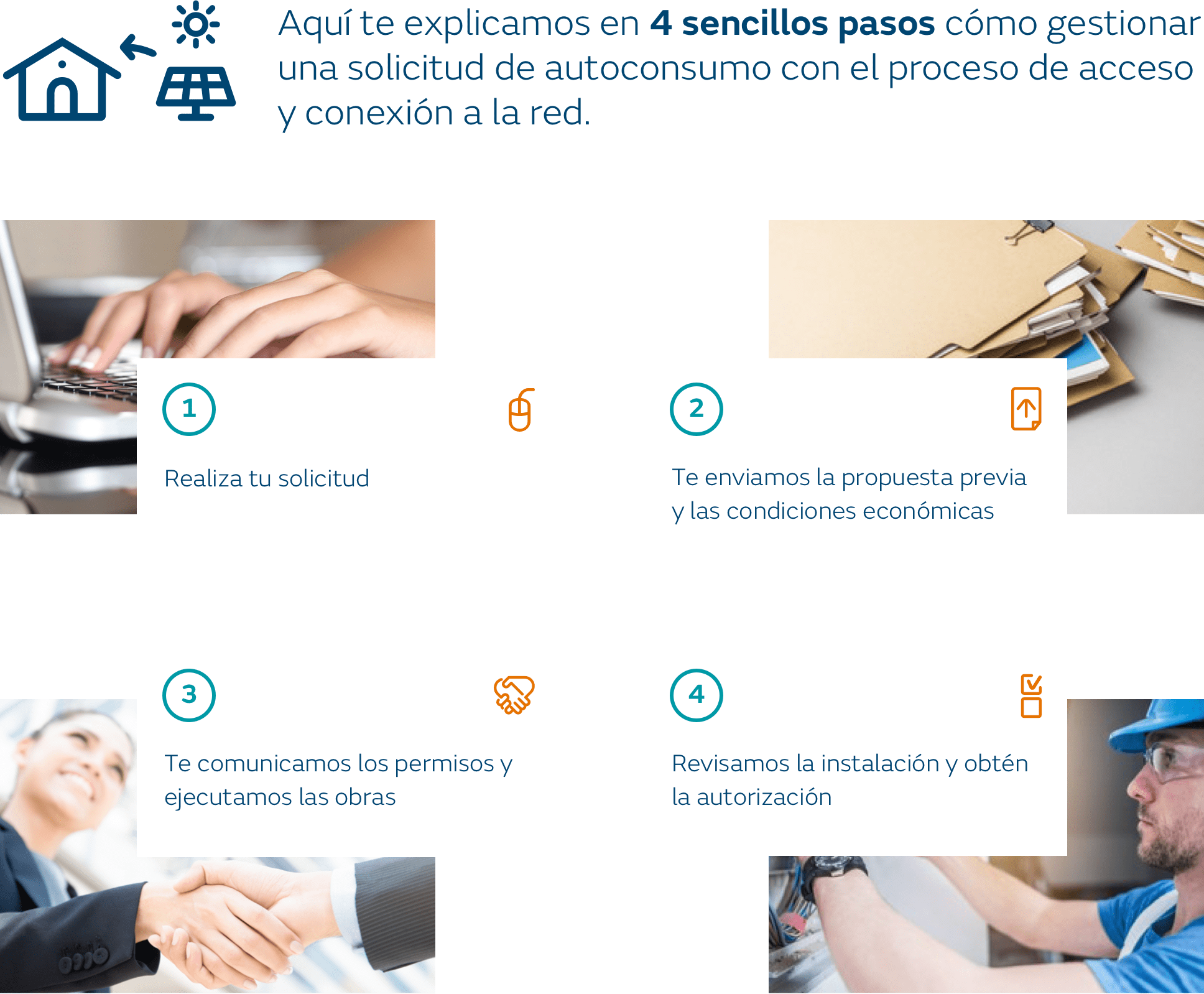
Access and connection process.
Realiza tu solicitud
- Accede al apartado Mis conexiones a la red del Área Privada. ¡Regístrate!
- Te pediremos los siguientes datos:
- Personales (nombre, NIF, correo electrónico, teléfono)
- Datos del tipo de instalación y potencia
- Datos de la central (nombre, referencia catastral, potencia)
- Envíanos los documentos que te especificamos
- Recuerda que para que el proceso de solicitud sea válido,la solicitud debe ajustarse en todo momento a los requisitos legales.
Te enviamos la propuesta previa y las condiciones económicas
- Cuando validemos la documentación, estudiaremos la solicitud teniendo en cuenta las características de tu instalación.
- No olvides que tu instalación debe cumplir con la legislación, los reglamentos y la documentación técnica vigente.
- Te enviaremos el punto del acceso y conexión y las condiciones económicas (en caso de que las haya).
Te comunicamos los permisos y ejecutamos las obras.
- En caso de que sea necesario que ejecutemos alguna obra, te enviaremos el presupuesto y, una vez hayas realizado el pago, la ejecutaremos.
- Antes de revisar tu instalación, te solicitaremos la siguiente documentación:
- El CIE
- La revisión del informe 59N (para los casos de Media Tensión)
- La solicitud de conexión
Revisamos la instalación y obtén la autorización.
- Una vez la hayamos revisado, podrásconectar tu instalación.
- Posteriormente, realizaremos el contrato técnico y te enviaremos el Código de la instalación de producción a efectos de liquidación (CIL) y el informe del gestor.
- Si eres autoconsumo con Potencia <=100 kW, deberásinscribir el autoconsumo en el correspondiente registro de tu comunidad autónoma.
- No olvides que, una vez que hayas inscrito y legalizado tu instalación en tu comunidad autónoma, tendrás que comenzar los trámites de contratación con tu comercializadora.
Realiza tu solicitud
- Accede al apartado Mis conexiones a la red del Área Privada. ¡Regístrate!
- Te pediremos los siguientes datos:
- Personales (nombre, NIF, correo electrónico, teléfono)
- Datos del tipo de instalación
- Datos de la central (nombre, referencia catastral, potencia)
- Envíanos los documentosque te especificamos
- No olvides abrir tu solicitud en un punto que cuente con capacidad suficiente de acceso para generación. Consulta la capacidad aquí
Te enviamos la propuesta previa y las condiciones económicas
- Cuando validemos la documentación, estudiaremos la solicitud teniendo en cuenta las características de tu instalación.
- En caso de que la instalación lo requiera según la legislación actual, Red Eléctrica de España nos tiene que confirmar el accesoa la red de transporte.Consulta la documentación necesaria
- Te enviaremos la propuesta previa, que contendrá el puntode acceso y conexión y las condiciones económicas (en caso de que las haya).
Te comunicamos los permisos y ejecutamos las obras
- Cuando aceptes el punto de acceso y conexiónque te hayamos propuesto, te enviaremos los permisos de tu instalación
- En caso de que sea necesario que ejecutemos alguna obra, te enviaremos el presupuesto y, una vez hayas realizado el pago, la ejecutaremos.
- Necesitamos que nos envíes el proyecto detallado de tu instalación.
- Te comunicaremos la aprobación del proyecto.
- Y nos pondremos en marcha para ejecutar las obras.
Revisamos la instalación y obtén la autorización
- Cuando las obras estén finalizadas, comprobaremos la documentación para la puesta en marcha, revisaremos la instalaciónde medida, las protecciones y autorizaremos tu conexión.
- Además, realizaremos el contrato técnico de acceso, te enviaremos el Código de la instalación de producción a efectos de liquidación (CIL), el informe de medidas y el informe del gestor.
- En algunos casos, tendrás que firmar el contratode servicios auxiliares. A continuación, podrás contactar con la empresa comercializadoraque elijas. Tienes un listado de las comercializadoras enwww.cnmc.es
Applicable legislation
Below you can find a list with part of the legislation that may be applied.
- Códigos de red y Norma de Técnica de Supervisión de Generadores
- Royal Decree Ley 23/2020
- Ley del Sector eléctrico 24/2013 de 26 de diciembre
- Royal Decree Ley 15/2018
- Royal Decree 1955/2000
- Royal Decree 1110/2007 (Unified regulations for electrical system measurement points)
- Circular 1/2021
- Resolución de 20 de mayo de 2021 de la CNMC
- El Royal Decree 1699/2011 Applies to:
- All low-voltage technologies with power up to 100 kW.
- Cogeneration, biogas and biomass up to 1000 kW and voltage up to 36 kV.
- El Royal Decree 413/2014 Applies to:
- All technologies with a power rating of more than 100 kW or less than 100 kW and a voltage greater than 1 kV (except cogeneration, biogas and biomass)
- Cogeneration, biogas and biomass of more than 1000 kW or voltage greater than 36 kV
- El Royal Decree 244/2019 applies if you are self-consuming
- El Royal Decree 1183/2020, of 29 December, on access to and connection to electricity transmission and distribution networks
- Circular CNMC 1/2024, of 27 September, establishing the methodology and conditions for access and connection to the transmission and distribution networks of electricity demand facilities.